Dining Table vs Kitchen Table: Which Should You Choose? (November 2026)
Choose a kitchen table for everyday meals near food prep, and a dining table for a separate eating area or larger gatherings. The right choice depends on your room, seating needs and how you use the table.
On this page (7 sections)
- Dining table vs kitchen table: what is the difference?
- Which table is better for everyday meals?
- How much space should you leave around either table?
- Which shape works better for a kitchen or dining room?
- What materials suit daily kitchen use?
- Should you choose one table for both rooms?
- Which should you choose: dining table or kitchen table?
Choose a kitchen table for everyday meals near food prep, and a dining table for a separate eating area or larger gatherings. The dining table vs kitchen table choice comes down to room layout, seating needs and the way your household eats.
The names describe common settings, not strict table categories. A compact table can work in either room if its footprint and seating fit your routine.
This comparison covers daily use, room size, seating, shape and materials. We also include a dining set, a round table and 2 separate kitchen work surfaces for different needs.
 Best for kitchen overflow
SUPERJARE Kitchen Bakers Rack with Power Outlet
Dining table vs kitchen table: what is the difference?
A kitchen table is usually geared toward daily meals, while a dining table often serves a dedicated eating area or planned gatherings. Both can be simple or formal, and either can work in the other room when the dimensions fit.
Kitchen tables often sit close to counters, appliances or a breakfast nook. That location makes quick meals and conversation near the cooking area convenient, but it also puts the table in a busy path.
A dining table may be farther from the cooking zone, with more room around it for chairs and guests. In an open-plan home, the dining area can still be part of the kitchen, so measure the whole shared space.
A refectory table in a modern kitchen can offer a substantial dining focal point.
If you're still deciding on shape and finish, browse these kitchen table ideas for ways to match a table to your room.
Does the name change what the table can do?
Not by itself. A table's size, base, material and seating matter more than whether a retailer calls it a kitchen or dining table.
Check the product's dimensions and the number of seats it is intended to support. A dining table that fits your kitchen can serve daily meals, while a sturdy kitchen table can host a dinner with guests.
Which table is better for everyday meals?
A kitchen table is the natural fit for quick breakfasts, snacks and daily family meals near the cooking area. Choose it when you want a convenient spot without crossing the home to reach a separate dining room.
Think about how meals work in your household. If people eat in shifts, a smaller table may be easier to keep clear; if several people sit down together, make seating and legroom a priority.
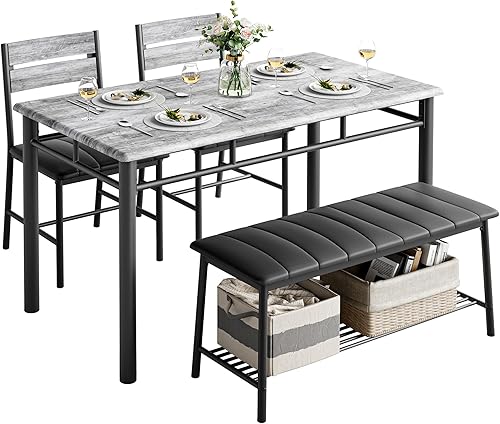
The IRONCK Dining Table Set includes a table, upholstered bench and 2 chairs, and is described for seating 4. Its seats tuck beneath the table when they aren't in use, which can help in a smaller room.
A kitchen table may also become a work or homework surface. Consider whether you need space for dishes and daily items to stay on the table, or whether you'll clear it after each meal.
When does a separate dining table make more sense?
A separate dining table makes sense when you have a dedicated eating area and want enough room for longer meals or guests. It can also help give dining a clear place away from the busiest cooking tasks.
Start with the number of people who usually eat together, then think about occasional guests. A table that handles both groups should fit the room without making everyday movement awkward.
For larger gatherings, compare dining table sets for eight.
If you plan for six seats, compare the table with your chairs and leave room to pull each one out. Our guide to a best dining table set for 6 can help you think through matching seating and table size.
How much space should you leave around either table?
Measure the table and the space needed to sit down, stand up and pass behind chairs. The tabletop footprint alone won't show whether a table will block a doorway or kitchen work area.
Mark the proposed table size on the floor with painter's tape. Place chairs along the edges and try the paths you use most, including routes to cabinets, the refrigerator and the room entrance.
A round tabletop can make movement around a table feel less constrained where people approach from several sides. A rectangular top can use a long, narrow area efficiently, but its corners and chair positions need clearance.
For a smaller home, consider whether a folding option could serve occasional meals and store away afterward. This guide explains what a folding dining table is and how it's used.
Can a bench save room?
A bench may tuck under a table more fully than chairs, depending on its shape and the table's base. Check the seat depth and leg placement so the bench can slide in without hitting supports.
The IRONCK set combines a bench and 2 chairs, with seats designed to tuck beneath the table. Its table measures 43.3 x 27.6 x 29.9 in, so compare those dimensions with your taped floor plan and the room's walkways.
A built-in banquette is another way to plan seating along a wall. Read what a banquette table is before choosing that layout, since fixed seating changes how people enter and leave the table.
Which shape works better for a kitchen or dining room?
Choose the shape that fits your room and keeps seating comfortable. Round tables avoid corners, while rectangular tables can align with a wall or longer room.
A round table can make it easier for people to talk across the surface. It still needs enough room for chairs and passage, and a large round top can take up more floor space than expected.
The Jocoevol Round Dining Table has a 46 in round top and is described for 4 to 6 people. Its storage shelf can hold tableware, and its cross-shaped base leaves room to tuck stools underneath.
A rectangular table can suit a narrow kitchen or dining area. Check whether the long sides leave enough room to sit, and whether anyone needs to pass behind occupied chairs.
For a darker finish, compare styles in our guides to black dining tables and dark dining table sets. Choose based on the room's light, other furniture and how much contrast you want.
Should the table have a pedestal base?
A pedestal or central base can leave more open floor around diners than legs at each corner, but the base still needs to fit the seating positions. Check where feet and chair legs will sit before deciding.
The Jocoevol uses a cross-shaped base, which is one example of a central support layout. Its table is 46 in across, so account for that full diameter and the room for seats around it.
What materials suit daily kitchen use?
Choose a surface you can care for easily and that matches the meals and tasks you expect. A kitchen table may face more frequent spills and wiping than a table used mainly for planned dinners.
If you are weighing wood materials, learn whether rubberwood is good for a dining table.
Engineered wood and metal can be practical in a home dining set. The IRONCK table uses those materials, and its smooth surface is described as easy to wipe clean.
A stainless steel work surface suits food preparation, but it doesn't provide the warmth or seating arrangement of a dining table. The Vevor Mophorn Stainless Steel Work Table 36x24 offers a 36 x 24 in top, 4 wheels and an adjustable lower shelf.
Treat dining surfaces according to their care instructions. Use placemats or a tablecloth if you want a barrier between dishes and the finish, and avoid placing hot cookware on a surface unless its care guidance allows it.
Is a separate prep surface useful?
A separate prep surface can help when counters are crowded or several people cook at once. It lets the dining table stay set for meals while you keep ingredients and tools in a work area.
The Vevor work table has 4 wheels, with brakes on 2 wheels, and a lower shelf with adjustable height. It is designed as a kitchen prep table, so consider it for kitchen tasks rather than as a seat-height dining table.
The SUPERJARE rack can add storage beside a kitchen work area. It has 3 shelves with adjustable placement, 2 power outlets and 6 S-shaped hooks, making it useful for a coffee maker, microwave or mugs without adding another dining surface.
If you're wondering about a rotating centerpiece and its materials, read is the Lazy Susan table sustainable?.
Should you choose one table for both rooms?
Use one table for both roles when it fits the room and works for your everyday routine. A flexible table can make sense in an open-plan home or a small apartment with no separate dining room.
Prioritize the main use, then check the secondary one. If you eat at the table each day and host occasionally, choose for daily seating and circulation first; guests can use extra chairs when needed.
If the table must change roles, leave room to move chairs and carry dishes between the kitchen and dining area. A folding table may help for extra guests, while a rack or cart can take on storage and prep tasks.
Don't expect one table to solve every space problem. A dining surface, a separate prep stand and a storage rack each serve different jobs.
Which should you choose: dining table or kitchen table?
Pick a kitchen table if daily meals near cooking are your main need, and pick a dining table if you want a dedicated place for longer meals or guests. In either case, choose by measurements, seating and traffic paths rather than the name.
For a small household, start by measuring the available floor area and marking the seats you need. For a dining room, consider the largest group you host and whether a round or rectangular top fits more naturally.
If you need a matched seating set, compare a best dining table and chairs set. If your kitchen counters need help more than your seating does, a prep table or storage rack may be the better addition.
Frequently asked questions
Is a kitchen table different from a dining table?
A kitchen table is usually placed in or near the kitchen for daily meals, while a dining table serves a separate eating area or formal gatherings. The terms describe common use, not a fixed table design, so compare dimensions, seating and materials for the exact table you want.
Can you use a dining table in a kitchen?
Yes, if its size and shape leave room to walk, open nearby cabinets and pull out chairs. Measure the table and the full seating area, then check the kitchen's traffic paths before choosing a dining table for everyday use.
What shape works best for a kitchen table?
Choose a shape that fits the room and its traffic paths. A round table can work well where people move around it from several directions, while a rectangular table may suit a narrow room.
Mark the footprint with tape and test chair clearance before buying.
How many people can a kitchen table seat?
Seating depends on the table's dimensions, shape and the chairs or benches around it. Check the maker's seating guidance, then allow enough room for each person to sit and get up.
A 46 in round table like the Jocoevol is described for 4 to 6 people.
Can a kitchen table also be used for food prep?
It can handle light prep if its surface is suitable and you protect it from heat, moisture and cutting damage. For frequent prep, a separate work surface may be more practical; the Vevor stainless steel table is designed for food prep and has a 36 x 24 in top.


